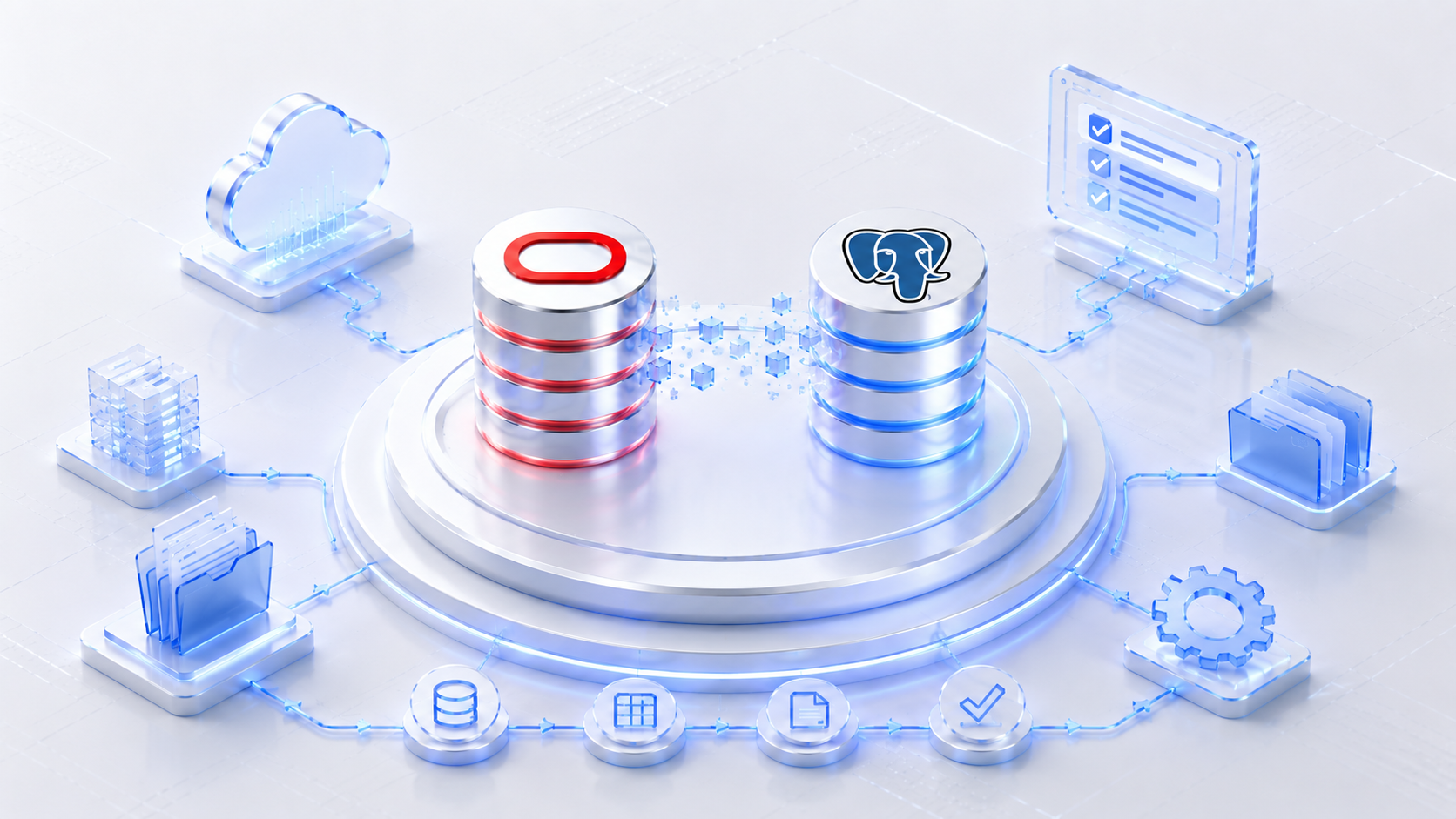
This case study explores the migration of a legacy Oracle database system to PostgreSQL an open-source, enterprise-grade relational database management system (RDBMS). The primary purpose of this study is to detail the motivations, processes, challenges, and outcomes associated with this transition, providing a structured framework that other organizations can reference when planning a similar migration.
Software Development, IT Services, and Digital Transformation Solutions.
Global company with large numbers employees and offices across multiple countries
Oracle , PostgreSQL
The organization needed to modernize a legacy Oracle database environment to reduce licensing costs, improve performance, avoid vendor lock‑in, and align the data layer with more agile, cloud‑compatible delivery models.
Database modernization and migration consulting
Client modernized a legacy Oracle database by migrating to PostgreSQL to reduce cost, improve performance, and remove dependency on a proprietary database platform. Through structured schema conversion, controlled data migration, procedural refactoring, and performance tuning, the engagement delivered measurable savings and a stronger foundation for scalable, cloud‑aligned application delivery.
The client faced four critical operational and security challenges that were inhibiting growth and increasing risk:
Oracle’s commercial licensing and annual maintenance fees consumed a significant portion of the IT budget, leaving limited room for innovation. As data volumes grew, incremental licensing and hardware requirements further increased total cost of ownership.
Dependence on a proprietary database platform constrained the client’s ability to freely adopt cloud‑native services and open‑source technologies. Architectural decisions were often driven by licensing constraints rather than optimal technical design.
Decades‑old schemas, stored procedures, and triggers written in PL/SQL made change management slow and risky. Tight coupling between application logic and database features complicated modernization and refactoring efforts.
Existing performance tuning and scaling strategies had reached their limits, leading to growing query latencies, CPU utilization, and storage consumption. Supporting new high‑traffic applications required more flexible scaling options than the legacy stack could comfortably provide.
The size and complexity of the database raised fears of extended downtime, data inconsistency, and regression issues if migration was not carefully planned. Business stakeholders needed strong assurance that customer‑facing services would remain stable throughout the transition.
Techanek designed a three-phase automated infrastructure deployment architecture built on native AWS services
A comprehensive assessment captured schema complexity, data volumes, application dependencies, and performance characteristics.
This informed a migration blueprint that defined target PostgreSQL environments, downtime windows, rollback plans, and tool selection (SCT, DMS, ora2pg).
The team adopted a two‑step approach: Schema Migration Tool (SMT) followed by Data Migration Tool (DMT).
Oracle objects—tables, indexes, sequences, constraints, and PL/SQL—were first converted to PostgreSQL syntax, and then data was replicated using tools like AWS DMS or ora2pg.
Tools such as AWS Schema Conversion Tool (SCT) and ora2pg automated conversion of Oracle data types (NUMBER, DATE, CLOB, BLOB, VARCHAR2) to PostgreSQL equivalents (NUMERIC/BIGINT, TIMESTAMP, TEXT, BYTEA, VARCHAR). Sequences, views, and synonyms were re‑implemented using PostgreSQL conventions like SERIAL/IDENTITY columns and compatible SQL syntax.
Data migration was performed with live replication using AWS Database Migration Service (DMS) or ora2pg streaming, keeping PostgreSQL nearly in sync with Oracle. Final cutover involved a short freeze window, reconciliation, and switching application connections to PostgreSQL with minimal downtime.
Post‑migration, the team used EXPLAIN ANALYZE, ANALYZE, and PostgreSQL configuration tuning (work_mem, shared_buffers, effective_cache_size) to optimize query plans. Row counts, checksums, sampling, and application‑level tests validated data integrity, functional behavior, and performance before full production rollout.
Oracle
PostgreSQL
AWS Schema Conversion Tool
AWS Database Migration Service
Tag Policies
The automation transformation delivered measurable impact across security, efficiency, and scalability dimensions:
Annual Oracle licensing and support costs were high and rising, consuming budget that could otherwise fund modernization and innovation.
Migrating to PostgreSQL reduced annual database costs by approximately 45%, with total operational savings reaching up to 60% when licensing and maintenance fees were eliminated.
Query response times and CPU utilization were steadily increasing, and scaling the environment often required expensive hardware and complex licensing discussions.
PostgreSQL tuning and index optimization delivered 25–40% faster query performance, a 20% reduction in CPU utilization, and roughly 30% lower storage usage.
Tightly coupled Oracle‑specific features limited the ability to adopt cloud‑native patterns, microservices, and modern data structures such as JSON and geospatial extensions.
PostgreSQL’s open‑source model and rich extension ecosystem (e.g., PostGIS, TimescaleDB) enabled greater architectural flexibility, cloud‑native integration, and faster delivery of new application capabilities.
Concerns about migration risk, data integrity issues, and downtime slowed modernization plans and made stakeholders cautious about major changes.
A well‑planned, tool‑assisted migration with rigorous validation demonstrated that large‑scale database transitions could be executed safely, increasing confidence in future modernization initiatives.
Standardized methodology from assessment through cutover, reusable for additional databases and business units.
Use of SCT, DMS, and ora2pg to minimize manual translation effort and reduce human error in complex migrations.
Automated integrity checks, performance benchmarks, and regression tests embedded into the migration pipeline.
Systematic tuning of PostgreSQL parameters, indexes, and queries to fully realize performance and cost benefits.
The migration from Oracle to PostgreSQL proved to be a strategic success, achieving significant cost reductions, performance enhancements, and operational flexibility. By leveraging open-source tools, rigorous planning, and iterative testing, the organization ensured a smooth transition with minimal downtime.